
DTG vs DTF Printing for Print on Demand
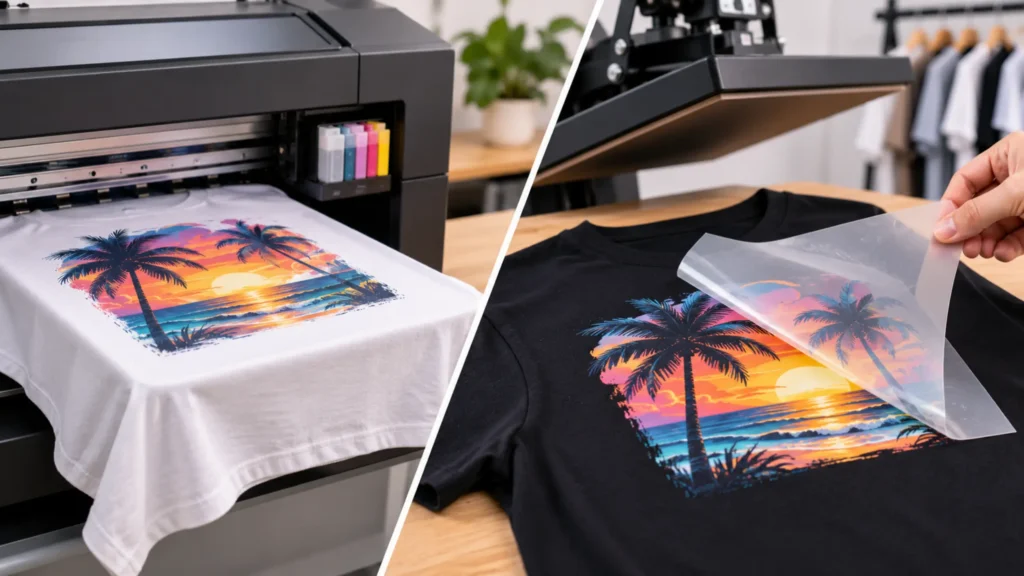
DTG and DTF are the two most common print-on-demand methods for apparel, and the right choice comes down to your fabric and your artwork. DTG, or direct-to-garment, prints water- based ink straight into the fabric, which gives full-color, photo-quality results with a soft feel on cotton. DTF, or direct-to-film, prints the design onto a film and heat-presses it onto the garment, which works on cotton, polyester, blends and nylon with a slightly raised finish. Neither method needs a minimum order, so you can test both on a single piece. This guide shows how they
compare, when to use each one and how to prepare your artwork for a print-on-demand service.
What Is DTG Printing?
DTG printing works like a high-end inkjet printer for clothing. It applies water-based ink directly onto the garment, and the ink bonds with the fabric fibers. Unlike screen printing, it does not need a separate screen for each color, so it can print unlimited colors in a single pass. That makes DTG printing a strong choice for photographs, gradients and detailed artwork. DTG works best on 100% cotton and cotton-rich garments, with 80% cotton or more giving the best results. Dark garments need a white underbase layer so the colors stay opaque, which adds a slight texture to the print.
What Is DTF Printing?
DTF printing prints your design onto a special film first. A powder adhesive is applied, and the film is heat-pressed onto the garment, where the adhesive bonds the design to the fabric. The process also uses water-based inks, and the result is a soft, flexible print with strong color vibrancy.
Because the design is transferred instead of printed into the fabric, DTF works on cotton, polyester, blends, nylon, canvas and more. A white underbase keeps the colors bright on both light and dark garments.
DTG vs DTF at a Glance
| Feature | DTG | DTF |
|---|---|---|
| How it is applied | Ink is printed directly into the garment | The design is printed on film, then heat-pressed onto the garment |
| Best fabrics | 100% cotton and cotton-rich blends (80% cotton or more) | Cotton, polyester, blends, nylon and canvas |
| Feel | Soft, retail-quality finish | Slightly thicker, slightly raised finish |
| Dark garments | Needs a white underbase, which adds slight texture | A white underbase keeps colors bright |
| Detail and color | Unlimited colors, photo-realistic images and gradients | Unlimited colors, full-color designs and bold vector logos |
| Extra step | None | A heat press applies the transfer |
| Minimum order | None | None |
| Larger volumes | Screen printing tends to cost less above 50 to 100 pieces | Screen printing tends to cost less above 100 pieces |
When to Choose DTG
Choose DTG when the garment is cotton or cotton-rich and the feel of the print matters.
- Photographic artwork and gradients. DTG captures every detail and blends colors smoothly.
- Soft, breathable finish. The ink bonds with the fibers, so the print does not sit on top of the fabric.
- Small batches and limited drops. With no minimums, you can print one shirt or one hundred.
- Personalization. Names, numbers and custom text are easy to add to each garment.
When to Choose DTF
Choose DTF when your catalog mixes fabrics or your design is built around bold, consistent color.
- Polyester, nylon and performance fabrics. DTF prints where DTG is limited to cotton-rich materials.
- Bold vector logos. Colors stay consistent across tees, hoodies and caps.
- Dark garments in mixed materials. The white underbase keeps the design vibrant on any background.
- Designs where a slightly raised finish is fine. The print sits on top of the fabric instead of soaking into it.
What About Embroidery?
If you are decorating hats, polos, jackets or bags, embroidery may fit better than either print method. Thread-based decoration adds texture and holds up through repeated wear. Embroidery works best with simple, bold designs and solid colors, so it suits logos more than photographs or gradients.
How to Prepare Your Artwork
For DTG, upload a PNG, which is preferred, or an SVG for vector artwork. Use 300 DPI, the sRGB color profile and a file under 50 MB. Export the file at the actual print size, for example a 10-inch-wide file for a 10-inch print. Printeez prints DTG and DTF designs up to 15 by 19 inches. The same high-resolution artwork works well for DTF.
Print on Demand With Printeez
Printeez offers DTG, DTF and embroidery with no minimums, so you can order one piece to compare the methods on your own design. Every order is produced in our own facilities in Lakewood Ranch, Florida and Granby, Quebec. Connect your store and orders flow to production automatically, or place orders directly without a store.
Learn more about our print-on-demand service, see how Shopify print on demand works, or read about print on demand in Canada.
Frequently Asked Questions
Both are durable when cared for properly. Wash garments inside out in cold water and avoid high-heat drying to get the longest life from either print.
DTG ink soaks into the fabric fibers instead of sitting on top, so it is not prone to peeling. Washing inside out in cold water and avoiding high heat keeps the print looking its best.
It depends on the design and the quantity. Neither method has a minimum order at Printeez, so you can order one piece of each and compare the cost on your own design. For larger runs, screen printing tends to cost less than either.
Yes. DTF works on polyester, nylon, and performance fabrics, unlike DTG, which is limited to cotton-rich materials.
Yes. A white underbase layer goes down first so the design stays opaque. It adds a slight texture to the print.
No. You can order a single item or thousands with either method.
DTG gives a soft finish on cotton-rich hoodies. DTF is the better choice for polyester or blend hoodies and for bold logos that need consistent color across fabrics.
